How to Price Siding Jobs More Accurately Knowledge Base
Learn proven strategies for pricing siding jobs that protect your margins and win more work. Stop guessing and start quoting with confidence.
Why Accurate Pricing Matters for Siding contractors
Pricing siding jobs accurately is one of the most critical skills you can develop as a siding installer. Get it wrong, and you either lose the job to a lower bid or win it and lose money in the process. Neither outcome grows your business. The goal is to find the point where your price reflects the true cost of the work, covers your overhead, and leaves room for a healthy profit margin that sustains your operation long term.
Too many siding contractors rely on gut feeling or competitor pricing when putting together a quote. That approach might work occasionally, but it is not a repeatable strategy. A disciplined pricing system built on real numbers and historical data will outperform guesswork every single time and give you the confidence to stand behind your bids.
Know Your True Costs Before You Quote
Before you can price any siding job accurately, you need to understand your fully loaded costs. That means going beyond the obvious materials like vinyl siding panels and fiber cement boards. You need to account for labor burden including payroll taxes and insurance, vehicle expenses, equipment depreciation, and general overhead like office costs, software, and marketing. Many siding installers forget about these indirect costs and wonder why their bank account does not match their revenue.
Consider a whole-house vinyl siding replacement as an example. Your material costs are just the starting point. How many labor hours will it realistically take, including setup and cleanup? What is your true hourly cost per worker when you add burden? What about drive time? Every hour your crew spends on the road is an hour they are not producing revenue, and that time needs to be captured somewhere in the bid.
Build a Repeatable Pricing Formula
A reliable pricing formula typically starts with direct costs, which are materials and labor for the specific job, and then adds a percentage for overhead and profit. Many successful siding contractors use a markup of one and a half to two times their direct costs, depending on the local market, job complexity, and their competitive position. The key is having a formula you trust instead of a number you hope works out.
If you handle both vinyl siding installation and fiber cement siding installation, you may find that different service lines require different markups. Siding repair and replacement jobs, for instance, might have higher material costs but lower labor intensity, which shifts the math. The most profitable siding contractors understand these nuances and price accordingly rather than applying a single flat rate across everything.
- Calculate your direct costs for every job including materials, labor, and permits
- Add your overhead as a percentage, typically ten to twenty percent of direct costs
- Add your profit margin on top, fifteen to twenty-five percent is a healthy target
- Review your effective rate per square foot against local market conditions
- Adjust for job complexity, site access, and any unique customer requirements
Avoid the Underbidding Trap
One of the biggest traps siding installers fall into is underbidding to win work. Cutting your price might fill your schedule, but if you are not covering your true costs plus profit on every job, you are essentially paying customers to let you work for them. Staying busy is not the same as being profitable. It is better to lose a job at the right price than to win it at a price that hurts your business.
The challenge of discovering rot or sheathing damage under old siding is a common reason bids come in too low. When you underestimate this factor, the extra time and cost come straight out of your profit. Similarly, weather windows for safe installation at height can add unexpected expenses that were never in the original bid. Accounting for these realities up front protects your margin.
Track Results and Refine Over Time
The best pricing strategies improve with data. After every job, compare what you estimated against what the job actually cost. Over time, you will see patterns. Maybe your labor estimates are consistently ten percent low, or maybe your material waste factor needs adjusting. This feedback loop is what separates siding contractors who guess from those who know.
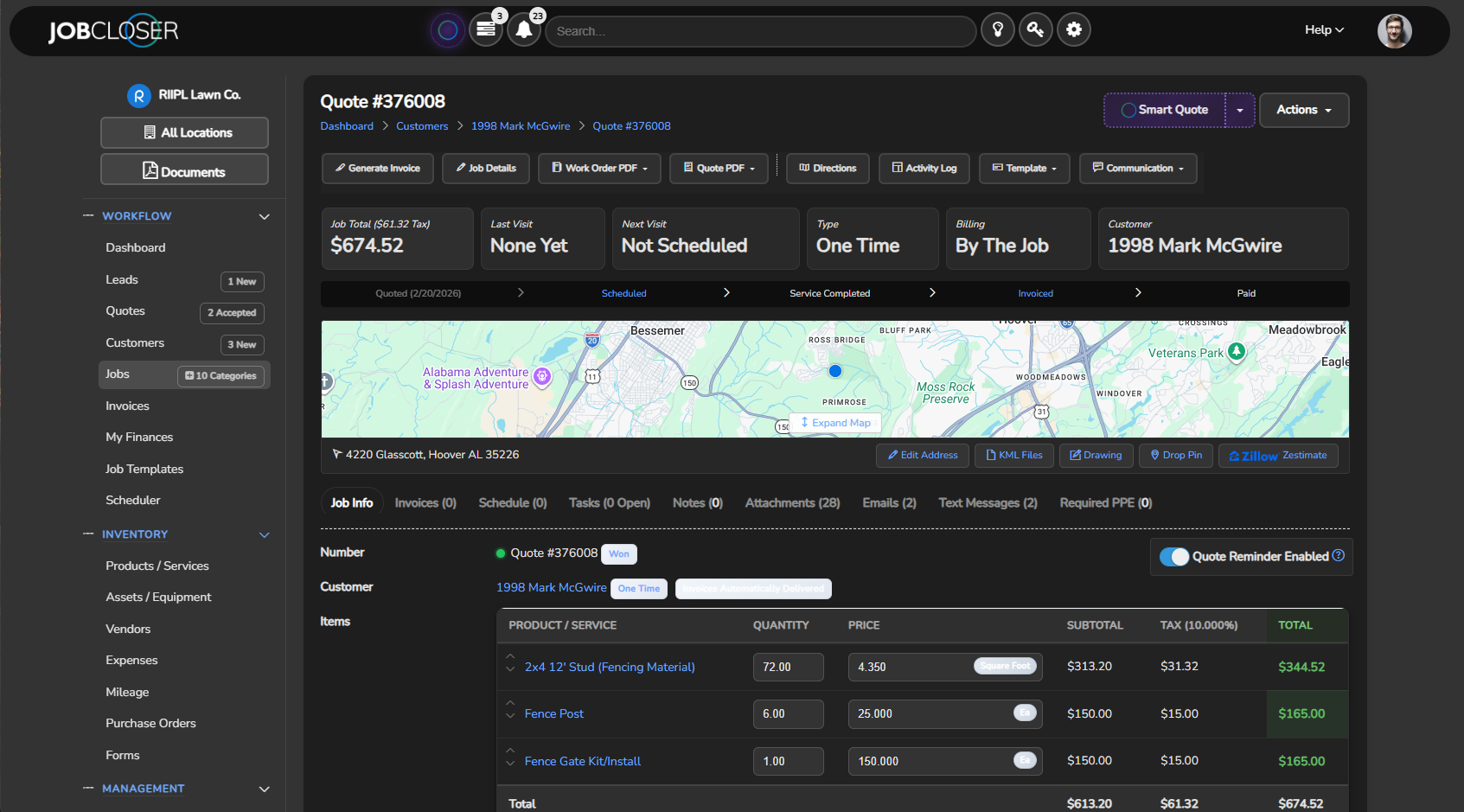
A platform like JobCloser makes this process easy by letting you build professional quotes, track job costs in real time, and run estimated versus actual comparisons on every project. Instead of relying on spreadsheets or memory, you get a clear picture of your pricing accuracy on every single job. Over time, that data becomes your most powerful competitive advantage.
Price With Confidence
Accurate pricing is the foundation of a profitable siding business. Take the time to understand your true costs, build a repeatable pricing formula, and use real job data to refine your approach. If you are ready to take the guesswork out of pricing, sign up for JobCloser and start building quotes that protect your bottom line. With tools like Orbit AI Smart Quoting, you can even generate estimates from a job description or uploaded plans, saving hours of manual work on every bid.
Discover the most common siding estimating mistakes and learn how to fix them before they eat into your bottom line.
Improve scheduling efficiency for your siding business with practical tips that reduce downtime, cut windshield time, and increase daily output.
Follow these invoicing best practices for siding contractors to get paid faster and maintain professional client relationships.
Stop chasing payments. Learn actionable strategies that help siding contractors collect what they are owed quickly and consistently.


More JobCloser
Field Service Mobile Apps
Run your field service business from anywhere. JobCloser mobile apps help your team manage quotes, schedules, jobs, invoices, payments, and customer updates directly from the field.


Try JobCloser Free
Field service management software with quoting, scheduling, invoicing, payments, CRM, and built-in AI. No credit card required. Cancel any time.
Start Free Trial